In commemoration of World Whistleblower's Day, this article examines the structural tension between Luxembourg's evolving legal framework for whistleblower protection and the financial centre's deeply embedded traditions of professional secrecy.
Drawing on recent Eurobarometer data, this analysis highlights the critical enforcement gaps, public trust deficits, and cultural barriers that must be addressed to transform nominal paper compliance into a functional systemic culture of integrity.
A legal framework built to protect those who speak up
Speaking up is rarely easy, and often comes at a cost. In Luxembourg, the legal framework for whistleblower protection was strengthened by the Law of 16 May 2023, which transposed Directive (EU) 2019/1937 on the protection of persons who report breaches of Union law. This law broadened protection beyond the financial sector and covers reports of breaches of national or European law made in a professional context.
The law is designed to protect a wide range of individuals, including employees, self-employed persons in certain situations, shareholders and members of administrative or supervisory bodies, volunteers, trainees, contractors, subcontractors, and anyone working under their supervision.
It applies when a person reports wrongdoing they learned about in connection with their work and does so through the channels established by law. Crucially, the law also extends its shield to facilitators, those who assist the whistleblower, and third parties who might suffer retaliatory consequences by association.
To operationalise this, the legislation requires many organisations to set up internal reporting channels and to acknowledge reports, follow up within set deadlines, and keep the identity of the whistleblower confidential.
It also outlines pathways for external reporting to competent authorities. In limited, high-stakes cases, public disclosure is permitted if an imminent risk to the public interest exists, or if standard channels are deemed ineffective or unsafe.
A cornerstone of this framework is the strict prohibition of workplace retaliation, including dismissal, suspension, demotion, negative performance reviews, intimidation, harassment, blacklisting, or any other professional disadvantage.
Several sector-specific regulatory institutions oversee this system, inter alia:
Financial sector matters.
Insurance-sector matters.
Data-protection issues.
Labour-related contexts.
While routing reports to the authority best equipped to investigate is logical on paper, this multi-tiered architecture can make the ecosystem challenging to navigate for potential whistleblowers who require clear guidance and absolute trust.
Major whistleblowing cases in Luxembourg
Luxembourg's modern whistleblowing narrative is inextricably linked to some of the most important transparency scandals in Europe. The most famous case remains the LuxLeaks scandal of 2014, which exposed hundreds of confidential tax rulings granted by Luxembourg to multinational companies. These arrangements allowed multi-jurisdictional groups to drastically reduce their global tax obligations. The disclosures fundamentally transformed the continental debate surrounding corporate tax transparency and forced hard political questions regarding aggressive tax optimisation strategies within smaller European states.
LuxLeaks demonstrated how exceptionally difficult it is for insiders to challenge systems historically rooted in institutional confidentiality.
The primary sources, Antoine Deltour and Raphaël Halet, faced protracted legal battles and severe public scrutiny. Their hardships became an international symbol of the immense personal and financial risks assumed by individuals who expose corporate practices that may be technically legal in form – the CJEU ruled that State aid in tax cases must be judged against national tax law – but remain deeply controversial in substance.
This milestone also highlighted the ecosystem between insiders and investigative journalism. Journalists like Edouard Perrin played an essential role in translating vast troves of complex, raw financial material into coherent public accountability narratives.
Global footprints: Panama Papers and CumEx
Similarly, the fallout from the global Panama Papers reinforced scrutiny on local financial structures. While the leak itself was global in scope, Luxembourg-based wealth managers, service providers, and corporate vehicles were deeply embedded in the systemic architecture of cross-border tax optimisation.
More recently, the country has been linked to the extensive investigations into CumEx and dividend stripping schemes. Insiders and leaked documents exposed how cross-border equity trading strategies were leveraged to claim multiple tax refunds on withholding taxes that had only been paid once, or not at all. Within this context, Luxembourg's estimated tax losses reached an unprecedented EUR 2.2 billion, emphasising the vulnerability of the country's prominent international finance, custody services, and fund administration sectors.
Ultimately, these combined cases prove that systemic misconduct within Luxembourg is rarely isolated to domestic operations; it is fundamentally intertwined with complex, cross-border corporate frameworks that demand insiders who understand exactly how these opaque systems operate.
Whistleblowers and anti-financial crime: a risky but essential role
Because Luxembourg serves as a primary international financial hub, even isolated insider disclosures can trigger sweeping ramifications for corporate brands and market confidence across the world.
This operational tension is exceptionally acute within financial crime enforcement. External regulators, compliance officers, and independent auditors can generally only evaluate historical documentation or macro-level data points.
Whistleblowers, conversely, provide the human context necessary to crack complex financial webs. They reveal the underlying intent: who knew about the systemic failures, precisely when they were informed, and how structural decisions were engineered to actively bypass compliance red flags.
In highly complex cases involving money laundering, structured tax evasion, sanctions evasion, or market abuse, insider testimony is frequently the deciding factor for enforcement.
Despite the enhanced legal protections enacted by the 2023 Law, the practical risks confronting financial professionals remain daunting. In an industry where career progression is entirely dependent on institutional trust, professional discretion, and tightly knit networks, the personal consequences of coming forward can be devastating. Whistleblowers frequently face lasting career displacement, aggressive reputational counter-attacks, civil litigation, and informal corporate blacklisting.
Beyond finance: whistleblowers in the health sector and other public services
The imperative for robust whistleblower protections extends far beyond banks, investment funds and tax desks. Non-financial arenas depend just as heavily on internal actors willing to sound the alarm when operational guardrails fail.
The healthcare sector represents a critical example. Nurses, physicians, laboratory technicians, pharmacists, and medical administrators are positioned to notice early indicators of unsafe clinical practices, patient safety violations, falsified medical records, fraudulent billing, inadequate staffing levels, substandard hygiene metrics, procurement irregularities, and institutional conflicts of interest.
In clinical environments, the real-world cost of silence is immediate, severe, and directly impacts human life.
Yet, much like the financial sector, medical cultures can discourage transparency, particularly when executive leadership prioritises institutional reputation over patient outcomes.
Similar dynamics exist across public administration, education, environmental protection, and social care. In every sector, whistleblowers function as an essential early warning system, exposing operational decay before it mutates into a public scandal or an irreversible crisis.
Culture, governance, and empirical realities
A strong whistleblower regime is not merely a matter of statutes and reporting channels. It fundamentally depends on culture and governance, which is precisely where many systems, including Luxembourg's, face their hardest test.
A law can prohibit retaliation on paper, but if the underlying workplace culture routinely punishes dissent, the legal right to report remains largely theoretical. In practice, people will only speak up when they have concrete reasons to believe that leadership will genuinely listen, investigate fairly, and protect them from being isolated or punished.
The pillars of internal governance
Boards, senior managers, and public leaders must make clear that reporting operational or ethical concerns is responsible risk management, not disloyalty.
Reporting channels need clear ownership, confidentiality safeguards, conflict-of-interest controls, and documented follow-up workflows.
Institutions must show that reports are reviewed promptly, investigated fairly, and closed with a clear explanation where possible.
The positive message encouraging whistleblowing must be consistently repeated and reinforced across corporate policies, training programmes, performance evaluation systems, and everyday executive decision-making. If managers instead treat incoming reports as personal attacks, or focus mainly on mitigating immediate reputational damage, employees quickly learn that the safest option is silence.
A whistleblower who raises concerns internally should never feel that their complaint simply disappears into the exact same corporate hierarchy that may be implicated in the misconduct. There must be separate, independent lines of responsibility so that reports can be assessed with complete objectivity.
A functional whistleblowing framework should be measured not only by how many reports are received, but by the quality of the organisational response and the degree to which the institution actively learns from what is reported.
The climate of fear and subtle retaliation
In professional sectors where confidentiality is highly valued and professional networks are small, individuals naturally worry that raising concerns will permanently mark them as difficult or unreliable. This anxiety is especially acute in ecosystems, where professional circles are tightly close-knit and professional reputations travel fast.
Even in the absence of explicit, formal retaliation, devastating informal consequences can occur, including systematic exclusion from key projects, the loss of future promotion opportunities, and long-term damage to future professional references.
For that reason, organisations must take the risk of subtle, informal retaliation just as seriously as obvious, overt disciplinary action.
Why enforcement gaps remain: empirical and structural realities
Despite stronger laws, important gaps still exist in practice because legal protection does not automatically create trust. Many people remain unsure where to report, what counts as a protected disclosure, or whether their identity will remain confidential. If reporting channels are too complex, too fragmented, or too slow, whistleblowers easily conclude that speaking up is too risky.
The 2025 Eurobarometer data help explain this institutional hesitation, illustrating who citizens actually trust and what specific barriers keep them silent. When asked whom they would trust most to deal with a case of corruption, responses heavily favoured traditional law enforcement and formal justice over political actors or administrative bodies.
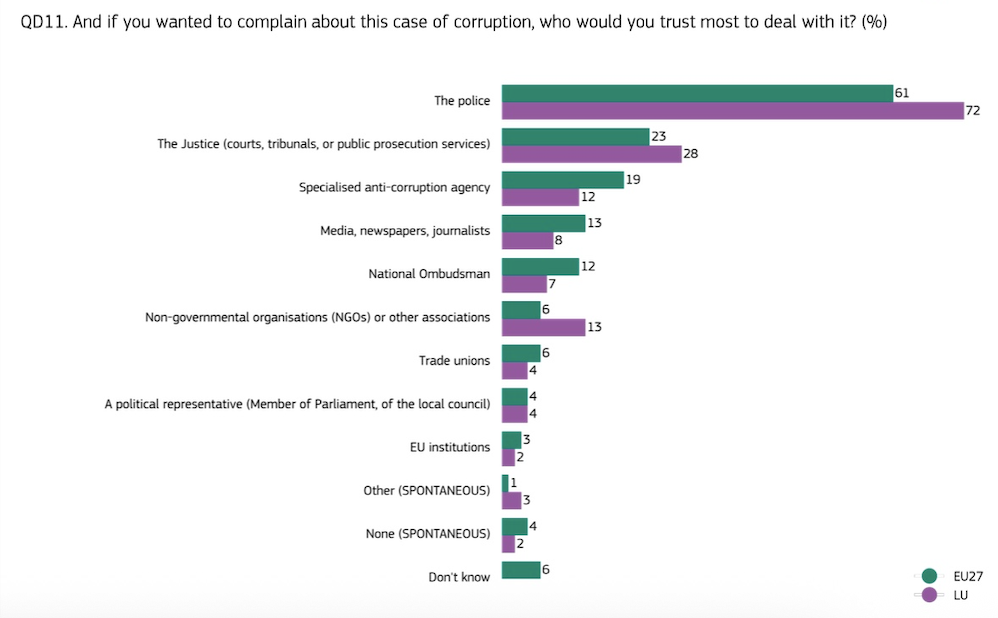
Luxembourg respondents who named the police as the most trusted authority to deal with a corruption case.
EU27 respondents who named the police.
Luxembourg respondents who said corruption is difficult to prove.
Luxembourg respondents who cited lack of protection from retaliation as a reason not to report.
These metrics highlight why clear, credible, and easy-to-use reporting channels matter: if people are unsure which authority will act effectively and impartially, they will stay silent even when they have real concerns.
The same survey sheds light on the top psychological, cultural, and logistical barriers preventing individuals from coming forward. Across the EU27, the most common reason is that it is difficult to prove the case, cited by 43% of respondents; in Luxembourg, that figure rises to 58%. The second most important concern is the lack of protection against retaliation, mentioned by 27% in the EU27 and 33% in Luxembourg.
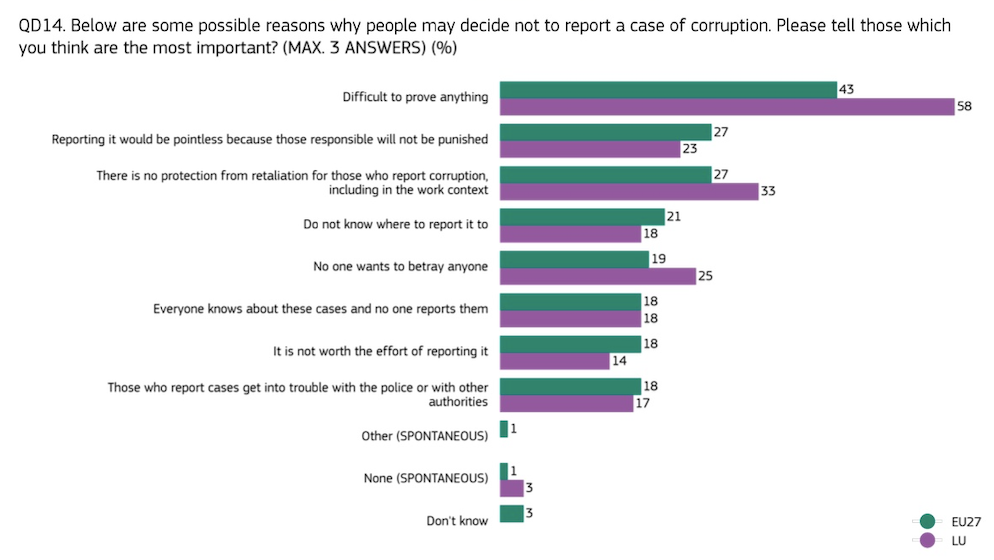
These results underline a central point of whistleblower protection: legal rights matter, but people will only use them if they believe the case can be proved, retaliation is effectively prevented, and the reporting channel is clear and reliable.
Systemic and structural impediments
Beyond individual hesitation, three main institutional gaps persist in Luxembourg:
Multiple competent authorities possess differing capacities, procedures, and levels of experience in handling whistleblower cases.
Confidentiality, international mobility, and complex cross-border activity can make wrongdoing structurally harder to detect.
Retaliation can be difficult to prove, while reinstatement, compensation, and reputational repair often come too late.
Some sectors are well supervised, while others are less visible. When external follow-up is slow and outcomes are not communicated clearly, it creates a public impression that reporting leads nowhere. Regulators must be approachable, responsive, and visibly willing to act to counteract this.
Luxembourg's success as a financial and corporate hub depends heavily on confidentiality, international mobility, and complex cross-border activity. These same features make wrongdoing structurally harder to detect and can create internal resistance to stronger transparency.
In sectors where business relationships are deeply interconnected and reputational concerns are intense, there is often a distinct reluctance to investigate or to support whistleblowers publicly.
A whistleblower who suffers retaliation still faces a difficult path because proving subtle, indirect discrimination in court is remarkably hard. Essential tools like psychological support or specialised legal advice remain difficult to access or poorly publicised.
A culture of protection is still needed
The strongest whistleblower law will only work if it is backed by a culture that genuinely respects public interest reporting. This requires moving past paper compliance to actively train managers, inform workers, safeguard confidentiality, and treat reporters as essential contributors to integrity rather than as workplace troublemakers. Whistleblowers are frequently the first line of defence against financial crime, corruption, and unsafe practices.
In Luxembourg, the legal framework is firmly in place and the institutional structure is more developed than before. However, the real test is whether people feel safe enough to use it. If Luxembourg wants strong markets, fair public services, and enduring trust in its institutions, it must look beyond paper compliance and robustly protect those who find the courage to speak up when something is wrong.