
Executive Summary
Following Luxembourg’s formal withdrawal from the Open Government Partnership (OGP) in 2023, the Grand Duchy has anchored its administrative modernisation in a "digital by default" national strategy. However, technical digitalisation does not automatically result in open, participatory, or accountable governance. On 20 May 2026, during Open Gov Week 2026, a panel of experts was convened by Luxembourg for Transparency (L4T) and the European Technology Intelligence for Citizens (ETICC) initiative. The panel was tasked with assessing the country's progress across three foundational pillars: open data infrastructure, deliberative democracy and right-to-information frameworks.
The Expert Panel Featured:
- Jamison Heninger, Open Data Manager (Open Data Watch / ODIN)
- Paul Braithwaite, Regional Lead, Europe (Open Government Partnership)
- Sana Hadžić-Babačić, Co-Founder (ETICC)
- Dr. Emilien Paulis, Political Scientist (University of Luxembourg)
- Professor Anamarija Musa (Faculty of Law, University of Zagreb)
- Dr Leena K. Hoffmann, Co-Founder (L4T), moderator
This report synthesises their insights to support evidence-based decision-making and policy improvements. The panel’s evaluation indicates that while Luxembourg excels in baseline technical data openness, substantial gaps in data coverage and a lack of descriptive metadata severely limit its real-world utility. Furthermore, while past ad-hoc citizen assemblies successfully depoliticised complex policy questions, the government's current preference for temporary, topic-specific consultations over a permanent institutional model, as highlighted in recent parliamentary debates and a January 2026 feasibility study, stalls structural democratic innovation. To build durable public trust, Luxembourg must transition from isolated, top-down consultative initiatives towards an integrated ecosystem of upstream co-creation, standardised public data coordination, and robust legal protections for access to public information.
Introduction
In modern public administration, governments frequently treat digital transformation as a direct substitute for open governance frameworks. Luxembourg exemplifies this trend; following its official exit from the OGP framework, the country pivoted towards internal digitalisation strategies to streamline citizen access. To assess the efficacy of this approach, the Transparency in Practice webinar in May 2026 evaluated whether technical infrastructure alone can deliver structural transparency and deep civic engagement.
Open governance requires recognising that data accessibility, public participation, and legal transparency are completely interdependent. When these spheres operate in institutional silos, public investments in digital portals fail to generate measurable social accountability or data reuse. This briefing translates the panel's assessments into actionable policy recommendations tailored to the distinct dynamics of Luxembourg's socio-political and multilingual landscape.
The Open Data Value Chain and Luxembourg's Infrastructure
A common error in digital governance is evaluating open data solely by the volume of files uploaded to public portals. As explained by Jamison Henninger of Open Data Watch, the true efficacy of open data is measured by a framework he refers to as the “Open Data Value Chain”. This conceptual framework demonstrates that data must successfully advance through four distinct operational phases to generate true public value:
- Collection: The gathering of raw baseline inputs.
- Publication: The process of making technical files accessible.
- Uptake: The access and subsequent analysis by users.
- Impact: The ultimate goal of informing policy and public debate.
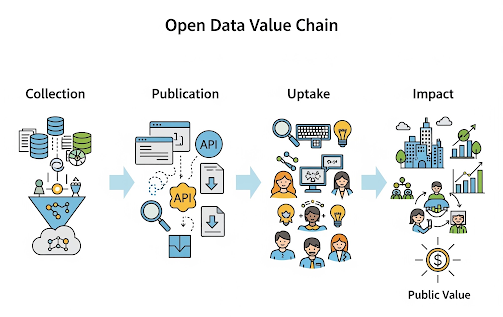
A severe bottleneck occurs at the uptake phase if data is distributed without descriptive context or standard formatting, rendering the information practically useless for journalists and researchers alike. Henninger highlighted this critical distinction during the panel: "Government producers must focus not just on uploading files, but on how users interact with and apply that data in sectors such as policy and journalism."
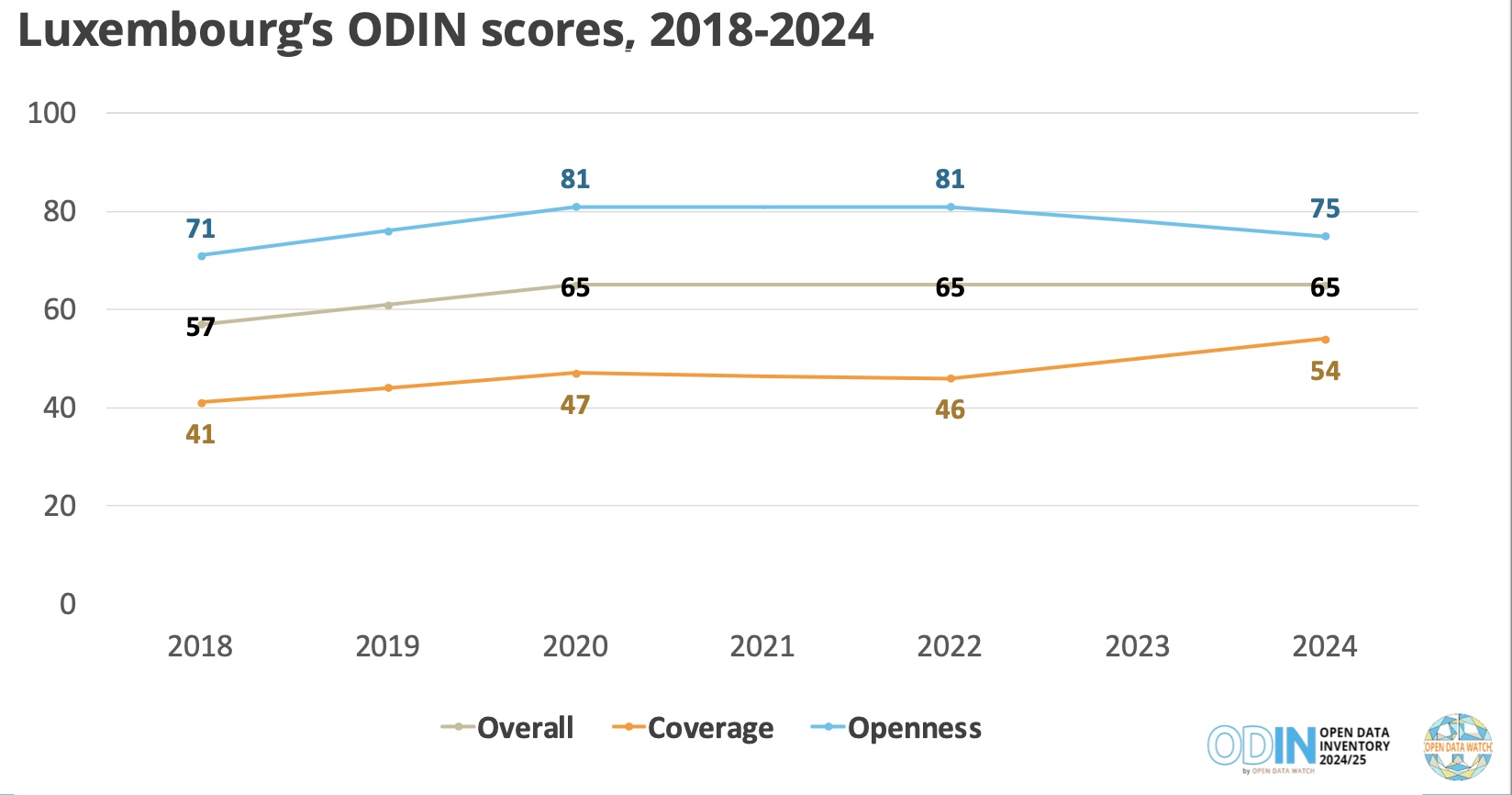
Performance Analysis via the 2024 Open Data Inventory (ODIN)
Luxembourg’s data infrastructure exhibits a distinct structural imbalance between technical openness and practical content utility. According to the 2024 ODIN results, Luxembourg ranks 61st out of 198 countries globally. A granular breakdown of its performance reveals specific operational features:
| Metric Evaluated | 2024 Score | Diagnostic Assessment & Structural Gaps |
|---|---|---|
| Overall Score | 65 / 100 | Represents moderate global standing while showing stable, intentional progress from a score of 57 in 2018. |
| Openness Score | 75 / 100 | High performance. Indicates strong adherence to machine-readable formats, open licensing, and unrestricted download options. |
| Coverage Score | 54 / 100 | Notable deficiency. Indicates gaps in data breadth, scope, and granularity across core socio-economic sectors. |
| Metadata Score | ~50 / 100 | Significant vulnerability. Reflects a widespread omission of basic reference metadata required to understand or track statistics over time. |
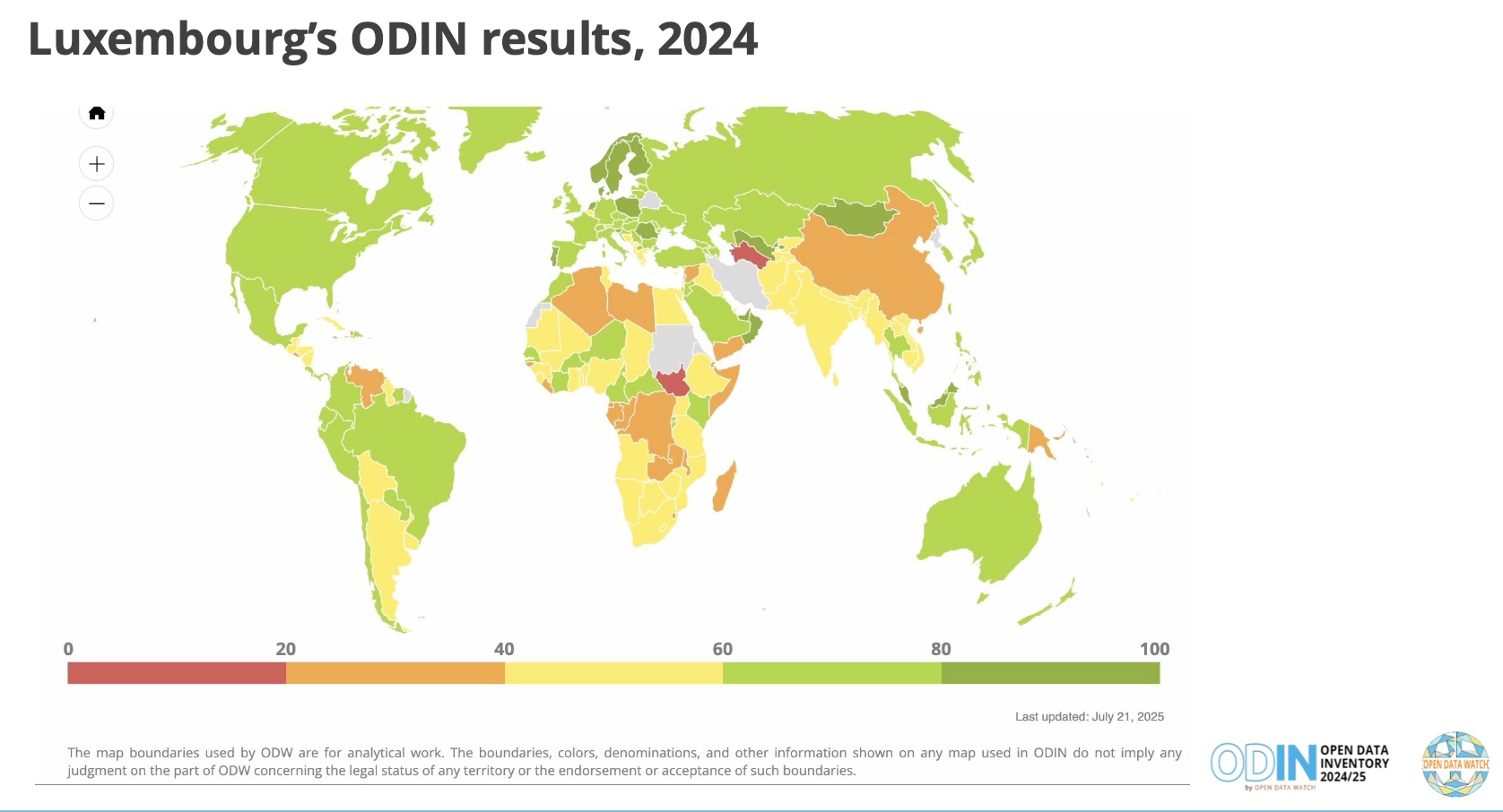
Data Omissions and Technical Bottlenecks
The low coverage score stems from a lack of high-value datasets covering essential living conditions, health outcomes, food security, nutrition, and environmental sustainability. Furthermore, Henninger noted that the systematic absence of sex-disaggregated data and granular sub-national data prevents civil society and public administrators from monitoring public services, local housing markets, and regional transport networks effectively.
Compounding these coverage gaps is patchy inter-agency coordination. The user experience remains highly fractured, with licensing agreements, file formats, and download options varying significantly between individual ministry websites and the national statistical office (Statec). Without central standardisation, the path to meaningful data openness remains unpredictable and confusing for end-users.
Shifting to Deliberative Democracy & The Institutionalisation Challenge
Public participation is shifting away from traditional majoritarian systems towards deliberative democracy models. This approach utilises citizen assemblies, composed of randomly selected, demographically representative cohorts of the population, to learn about complex policy issues, engage in collective reasoning, and develop consensus-driven policy recommendations. This process establishes an innovative governance dynamic known as deliberative accountability. Unlike standard electoral accountability, which is driven by majoritarian voting, short-term electoral cycles, and political polarisation, deliberative accountability requires political elites to provide rational, public justifications regarding why certain citizen proposals are accepted or rejected.
Dr. Emilien Paulis (University of Luxembourg) explained that while these assemblies help insulate complex, long-term challenges from short-term electoral pressure, they alter the expectations placed on elected representatives:
"Citizen assemblies help depoliticise complex issues like climate change and reduce short-term electoral pressure, but they create a dual dynamic where political elites are expected to explain why certain proposals are or are not adopted."
Paulis stressed the importance of institutionalising feedback loops between citizens and policymakers to shape legislation, asserting that transparent communication by political authorities is essential to rebuild public trust in decision-making processes.
The Institutionalisation Bottleneck in Luxembourg
Luxembourg proved the viability of deliberative models through two national experiments: an urban planning committee in 2021 and a climate policy committee (Klima-Biergerrot) in 2022. These bodies successfully included demographics typically left out of national politics, such as non-national residents and cross-border workers.
However, for these models to have a lasting impact, they must be institutionalised, permanently integrated into the legal structure so they operate independently of changing political coalitions. The January 2026 feasibility study commissioned by the Chamber of Deputies on institutionalising these models highlights the growing tension between citizen demand for participation and the preservation of traditional parliamentary structures. This followed parliamentary debates where the coalition government clarified that it has no plans to establish permanent citizen councils for general policymaking, favouring a more cautious, bounded approach that utilises temporary assemblies restricted to pre-defined, ad-hoc topics.
Structural Accountability vs. The Consultation Illusion
A core conclusion of the panel was that transparency alone does not automatically guarantee social accountability. Public engagement often fails when public authorities treat it as a passive, top-down consultation box-checking exercise rather than an active process of upstream co-creation.
Sana Hadžić-Babačić (Co-Founder, ETICC) noted that digital tool expansion cannot solve underlying deficits in trust or structural accountability:
"Participation mechanisms are insufficient if they lack trust and structure; transparency does not equal accountability, and public engagement often fails when it remains a consultation exercise rather than a process leading to visible, measurable impact. Civic technology should be used as an enabler for transparency rather than a standalone strategy, as digital platforms alone do not create participation."
She explained that for Luxembourg’s unique, multilingual, and highly interconnected environment, effective digital ethics policies and artificial intelligence (AI) frameworks cannot be designed in bureaucratic isolation. They require a multi-stakeholder approach where institutions, academia, and civic actors collaborate directly. Currently, this collaboration is hindered because grassroots civil society organisations (CSOs), particularly those focused on citizen engagement and access to information issues within Luxembourg, face persistent difficulties securing long-term, independent institutional funding.
Access to Information Frameworks: European Benchmarks & Institutional Friction
Within Europe, the right to know has evolved over the past 25 years from a niche legal procedure into a core pillar of the rule of law, transparency, and anti-corruption frameworks, strongly shaped by external mandates from the EU, OECD, and World Bank. This right is enshrined in supranational documents like the EU Charter of Fundamental Rights and the Council of Europe's Tromsø Convention on Access to Official Documents, which notably took 11 years to enter into force following its 10th ratification.
4.1 Luxembourg's Legislative Landscape
Luxembourg was the penultimate EU member state to adopt a formal freedom of information law in 2018; however, Luxembourg’s legal scope is remarkably narrow compared to regional benchmarks. Its transparency mandates apply only to administrative bodies, explicitly excluding the substantive activities of its non-executive government branches. Due to structural exceptions, the Luxembourg framework for freedom of information also suffers from transparency deficits. The public lacks access to the land registry, government sessions, aggregated lobbying details, and information requests, alongside asset and interest declarations for both the judiciary and top executive public employees, even though ministers' agendas remain accessible.
4.2 The "Soft Transparency" Diversion and Regional Backsliding
In her intervention, Professor Anamarija Musa (University of Zagreb; former Information Commissioner of Croatia) warned that the legalistic, procedural right-to-information movement has lost momentum over the last decade. With the rapid expansion of e-government, the focus of both public authorities and civil society has shifted towards softer, digitised versions of open governance, such as publishing standalone databases, launching web applications, and hosting public participation exercises.
In her view, this creates a significant institutional loophole:
"For public authorities, it is easier to open a certain database in collaboration with the civil society than to grant access to a document that could reveal misuse of financial resources, defectiveness in decision making or stir a public debate in general."
Concurrently, civil society organisations have refocused their resources on open data and civic tech, largely disregarding the necessary legal developments required to protect baseline access to information. Professor Musa explains that this trend is worsened by broader regional backsliding fuelled by defensive over-applications of the GDPR, systemic public distrust, and changing political elites, given that centre-left parties have historically shown a higher inclination to embrace access to information policies than conservative coalitions.
4.3 Practical Gaps and "Administrative Creativity"
The primary practical hurdle on the ground is a pervasive bureaucratic failure to understand that the public's right to know is the default rule, while preserving competing interests must be the strictly justified exception. This creates a paradox where countries in Eastern Europe and the Middle East often score exceptionally high on paper-based Right to Information (RTI) Ratings, yet suffer from severe implementation deficits on the ground.
According to Musa, rather than operating openly, public administrations frequently display "stunning creativity" in inventing ways to circumvent legal obligations and minimise public rights. She explained that this defensive posture is driven by a deep-seated fear of a "domino effect" or a worry that media and civic actors will misrepresent disclosed data.
In Musa’s opinion, overcoming this requires continuous education and identifying best practices to transform public authorities into active partners rather than defensive opponents. Simultaneously, the media must act as a crucial ally; as seen in jurisdictions like the United Kingdom, journalists can normalise rights awareness by explicitly stating in their reporting when information was obtained via an FOI or access request, signalling to the general public that this democratic tool is active and available.
She further explained that to enforce compliance and overcome this administrative friction, European states tend to rely on structured institutional oversight. As illustrated in Figure 4, jurisdictions choose from three primary structural models, ranging from general Ombudsman oversight to independent specialised commissions with binding enforcement powers:
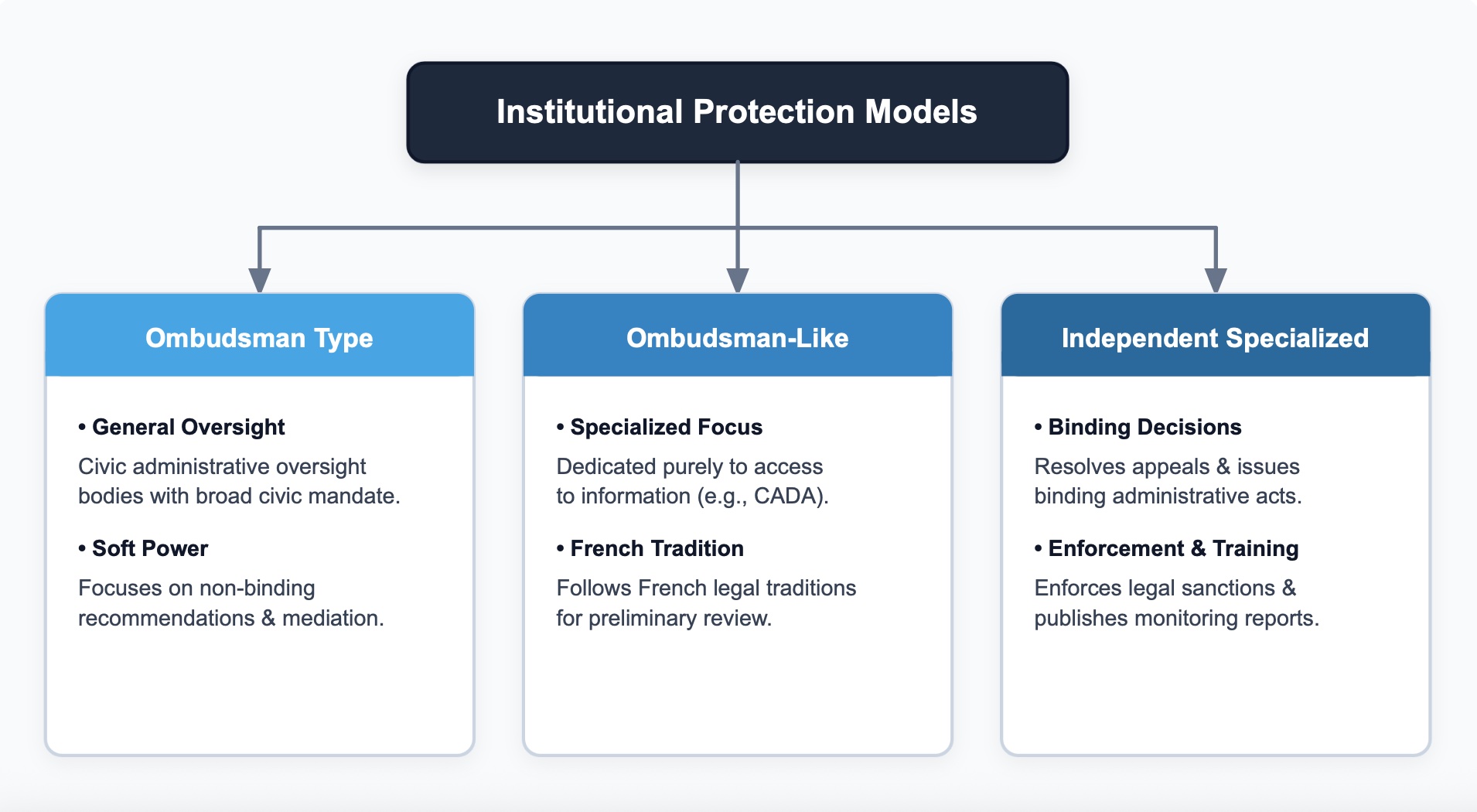
In Musa’s view, these specialised independent institutions (either operating exclusively for access to information or combining it with open data) are highly effective because they resolve appeals, issue binding administrative acts, enforce sanctions, track analytical monitoring, and run proactive training programmes.
Strategic Alignment with Modern OGP Frameworks
Even though Luxembourg officially withdrew from the OGP in 2023, formal membership remains unnecessary for adopting global best practices. According to Paul Braithwaite of the Open Government Partnership, the organisation recently modernised its operational framework to mitigate heavy administrative burdens on participating states. By shifting its core unit of action away from rigid, single national action plans towards adaptable, autonomous action commitments, the OGP now enables countries to introduce individual initiatives that align seamlessly with their domestic legislative calendars, while also extending commitment durations for up to six years.
Braithwaite emphasised that the value of an open government framework lies in recognising the deep connections between these policy areas:
"The core value of an open government lens is the interdependence between spheres of action like open data, public participation, and access to information. Government membership is not required to be part of the global Open Government Partnership community."
He asserted that by participating as an observer in regional dialogues and using OGP diagnostic tools, such as the Open Gov Guide; Luxembourg can design smarter public spending models and rebuild civic trust without incurring heavy administrative overhead.
Conclusion
Luxembourg stands at a pivotal governance crossroads in 2026. While its "digital by default" strategy provides a strong technological foundation, technology alone cannot replace open, inclusive democratic processes. True open governance requires recognising the absolute interdependence of open data, active citizen participation, and robust access to information.
The insights from the Transparency in Practice webinar demonstrate that navigating this transition requires structured and sustained political will as well as a cultural and mindset shift within public administrations. This involves moving away from defensive box-checking exercises and towards proactive collaboration adapted to Luxembourg’s unique local, societal, political and legal characteristics. By addressing structural data coverage gaps, establishing clearer metadata standards, and supporting civic intermediaries, Luxembourg can build an inclusive, accountable governance model that matches its status as a leading digital nation.
Recommendations
- Harmonise Data Coordination and Metadata Standards
Establish a unified open data protocol across all public ministries and Statec; ensuring uniform user experiences across all data access points is critical. Mandate that all future data publication include comprehensive reference metadata, standardised licensing, and uniform download formats to eliminate user fragmentation. Focus specifically on eliminating coverage gaps by publishing sex-disaggregated and sub-national data for housing, health, and transport. - Target Sustainable Funding for Civil Society Ecosystem
Formally embed dedicated institutional budget lines within national planning frameworks to provide sustainable, long-term funding for civil society organisations and academic research ecosystems specifically focused on citizen participation and freedom of information protection issues. This ensures that public co-creation remains continuous and is not tied to political coalition cycles. - Institutionalise Multilingual Civic Infrastructure
Institutionalise citizen assemblies as a regular feature of policymaking to ensure their mandate is not reliant on the political will of temporary coalitions. Build a professionalised, multilingual civic infrastructure incorporating skilled facilitation and neutral moderation to guarantee equitable access for Luxembourg's diverse population. To ensure tangible impact, implement formal feedback loops between citizens and policymakers to shape legislation, as transparent communication by political authorities is essential to rebuild public trust. - Reform Freedom of Information (FOI) Implementation
Conduct mandatory training for public authorities to shift administrative culture away from adversarial request management. Institute a mandatory "public interest balance test" to prevent the improper use of GDPR as a shield against legitimate public data requests. - Modernise Freedom of Information (FOI) Frameworks and Oversight
Upgrade national legislation to align with European regulatory baselines by extending transparency mandates across all public institutions and mandating the proactive disclosure of key datasets. This reform must institute rapid procedural timelines, implement mandatory public interest balance tests, and upgrade the powers of the Commission d'accès aux documents - CAD to empower them with binding authority to resolve appeals, enforce compliance of government entities, and lead administrative training.
Chamber of Deputies (2026). Feasibility study on institutionalising citizen assemblies. (Accessed: 19 July 2026).
Open documentNational Union of Journalists (n.d.). Defending the Right to Know. (Accessed: 19 July 2026).
Open websiteCouncil of Europe (2009). Tromsø Convention on Access to Official Documents. CETS No. 205. (Accessed: 19 July 2026).
Open websiteEuropean Commission (2026). 2026 Rule of Law Report: Recommendations. (Accessed: 19 July 2026).
Open documentEuropean Union (2000). Charter of Fundamental Rights of the European Union. (Accessed: 19 July 2026).
Open documentGovernment of Luxembourg (2026). Digital Government Strategy 2026-2030. (Accessed: 19 July 2026).
Open documentOpen Government Partnership (n.d.). Open Gov Guide. (Accessed: 19 July 2026).
Open websiteVerfassungsblog (2024). Why Europe Needs a Harmonised Access to Information Act. (Accessed: 19 July 2026).
Open websiteOpen Data Watch (2024). Open Data Inventory (ODIN): Luxembourg Country Profile. (Accessed: 19 July 2026).
Open websiteOpen Government Partnership (2023). Luxembourg withdrawn. (Accessed: 19 July 2026).
Open websiteWorld Bank (2013). The Right to Information: A Global Assessment. (Accessed: 19 July 2026).
Open documentWorld Justice Project (n.d.). Rule of Law Index. (Accessed: 19 July 2026).
Open website